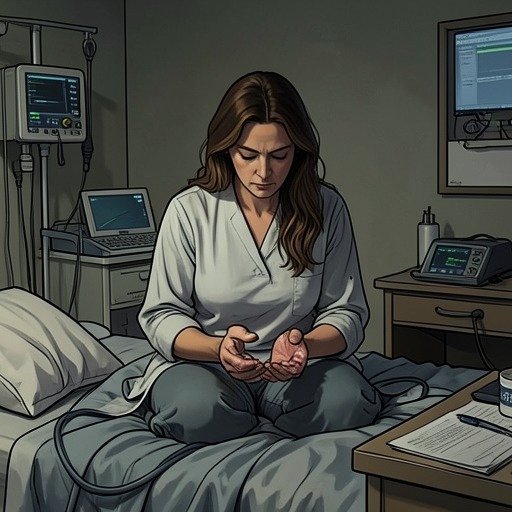
Adrienne’s emergency cesarean section and the birth of six pups
Insatiable Box Set: Books 1-4Adrienne’s emergency cesarean section and the birth of six pups are the major reproductive crisis of this part of the story. Adrienne’s body, previously declared incapable of bearing children after the assault she suffered in college, has become the site of an extraordinary werewolf pregnancy. The operation converts the family’s hopes for continuation into an immediate question of life and death: Dr. Wells must remove the pups before they are fully developed, and Drayton must authorize the procedure while knowing that Adrienne may not survive it.
Causes and Background
Adrienne’s pregnancy carries the weight of an earlier medical verdict. After two or three of Paul’s fraternity brothers entered her bedroom while Paul was unconscious, she was taken to a hospital and told that she could never have children. Paul and her parents then tried to suppress the assault, calling it an “incident” and insisting that Adrienne never speak of it again. Paul promised to marry her that June, but the promise became part of the silence surrounding her trauma rather than a restoration of her autonomy. Later, her pregnancy with werewolf pups reverses the human medical judgment that had defined her reproductive future.
The pregnancy is also embedded in the Samsa family’s reproductive strategy. Wilder explicitly explains that Mena is sterile and that Adrienne is expected to bear pups who would then be given to Mena and Drayton. That plan treats Adrienne’s fertility as a resource to be allocated among the family’s needs, even though Adrienne objects to decisions made over her body and demands that Drayton and Lycell be allowed to state what they themselves want. Drayton’s later declaration that he wants Adrienne and loves her makes the pregnancy not merely a biological solution to the werewolves’ fertility crisis, but part of an emotionally contested network of mate claims, marriage arrangements, and family succession.
Adrienne’s relationship with Drayton intensifies this conflict between care and reproductive expectation. He tells her that he will wait until she is ready before mating with her, and he says that he wants her and loves her. His tenderness gives the pregnancy an intimate dimension that contrasts with Wilder’s earlier attempt to manage the children’s future without Adrienne’s consent. Yet the eventual birth reveals the physical price of the family’s hopes: the pregnancy has carried six pups, a number Dr. Wells regards as enough to make Adrienne’s condition extremely dangerous.
Medical Emergency and Operation
The crisis begins when Lycell finds Adrienne turning blue, with her eyes rolled back, her eyelids closed, and her body cold. His panic is unusual because he is ordinarily difficult to shake. The narration recalls an earlier episode in which Lycell disappeared in the Alaskan wilderness during a blinding snowstorm, fought off a bear, and took over its cave; even after that ordeal, he retained enough humor to tell his father that the bear looked worse. His terror at Adrienne’s collapse therefore measures the severity of the emergency and the depth of his attachment to her.
Wilder carries Adrienne downstairs wrapped in a blanket as the doctor arrives with an ambulance. The doctor checks her neck and finds a low pulse, then orders that she be taken to the hospital immediately. Lycell wants to follow, but Wilder restrains him, telling him that he is too upset and that he must remain behind in case Ramsey returns with his pack. The emergency thus unfolds under two simultaneous threats: Adrienne’s failing body and the possibility of violence against the Samsa family.
At the hospital, the medical decision is presented without softening. The doctor asks which man is Adrienne’s father, and Drayton identifies himself as her fiancé. Dr. Wells then tells him that he must complete the forms and choose if the doctors face a direct conflict between saving the babies and saving Adrienne. Drayton says that he cannot make such a choice; Lycell collapses into a chair with his hands over his eyes, and tears fall onto his hands. The scene exposes the emotional cost of a system that turns intimate attachment into legal and medical responsibility at the moment of catastrophe.
Drayton nevertheless gives Dr. Wells permission to do whatever is necessary. At the emergency entrance, Dr. Wells explains that Adrienne will die without an immediate cesarean section. The pups are small, but that is expected because they are werewolves, and the doctor cannot guarantee that they will survive outside her body. Drayton accepts the operation’s risks and sits in the waiting area, texting Wilder. The decision preserves the possibility of six new lives while leaving Adrienne’s survival uncertain.
Birth of the Six Pups
The operation succeeds for the pups. When Dr. Wells emerges, he reports that they are fine for the moment, although he does not know whether Adrienne will live. He says that carrying all of them took a great deal from her, but that the pups appear healthy. Wilder initially focuses only on Adrienne and demands to know whether she will survive; Drayton asks the question Wilder fails to ask, namely how many pups were born.
Dr. Wells answers that Adrienne has delivered six male pups. The number transforms the crisis into a family expansion of exceptional scale. Wilder already has twins waiting for their mother, and the six newborns add another generation of male werewolves to the Samsa family. Drayton immediately asks whether Adrienne will be able to have more children. Dr. Wells cannot give a definite answer, but he sees no absolute reason why she could not; nevertheless, he advises against another pregnancy. The medical warning places a limit against the family’s reproductive ambitions even as the birth appears to fulfill them.
Lycell’s response reveals how incomplete the apparent victory is. He celebrates that the pups are safe and insists that Adrienne is tough and stubborn, but Wilder finally tells him that she may not survive the delivery. Lycell refuses to accept the possibility of her death, then asks to see her. His confidence in Adrienne is not medical knowledge; it is a desperate form of attachment that tries to keep the worst outcome from becoming real. The birth therefore produces no uncomplicated celebration. Six healthy sons exist, but their mother remains in urgent care, sedated and critically endangered.
Consequences for Family and Authority
The cesarean section confirms that the Samsa family’s reproductive future depends on human bodies and medical systems that its werewolf customs cannot fully control. The family has treated Adrienne’s fertility as an answer to sterility and population decline, but the operation makes the hidden cost visible. A reproductive plan that promises six male heirs also creates an emergency in which the mother may be sacrificed to secure them. Dr. Wells’s warning against another pregnancy challenges the assumption that successful birth proves the safety or legitimacy of repeated gestation.
The event also redistributes authority among the men surrounding Adrienne. Wilder claims family responsibility and identifies himself as part of Adrienne’s family, while Drayton is forced into the formal role of fiancé and decision-maker. Lycell, though emotionally invested and openly devastated, has no authority in the hospital and must be kept away because his distress could become dangerous. Their different positions—family leader, fiancé, and anguished mate—show how the crisis exposes both solidarity and competition within the Samsa household.
The later arrangement involving Mena and Robert places the birth within a broader pattern of sanctioned family formation. Wilder approves the marriage between Mena and Robert and welcomes Robert to remain as the family doctor, linking intimate partnership, medical care, and political stability. Mena later reveals that Robert’s experimental drug has restored her fertility and made her pregnant. Her pregnancy provides a parallel to Adrienne’s: both women’s reproductive futures are altered through extraordinary intervention, but Adrienne’s change leads to a dangerous operation while Mena’s experimental treatment offers the possibility of rebuilding fertility without the same immediate crisis.
Narrative Significance
The event reverses Adrienne’s earlier presumed infertility and the hospital’s declaration that she could never have children. It also reverses the emotional expectation that pregnancy will simply validate the Samsa family’s shared-mate arrangement. Instead, the birth becomes a test of whether the family values Adrienne as a person or primarily as the bearer of pups. The question is never resolved through a simple triumph: the pups are healthy, but Adrienne is sedated, in severe pain, and possibly dying.
As a plot turn, the episode combines discovery, sacrifice, and reversal. The discovery is that Adrienne has carried six male werewolf pups. The reversal is that the long-awaited reproductive success immediately threatens the mother who made it possible. The sacrifice is not described as voluntary heroism; it emerges from the pressure of fertility expectations, the limits of medical knowledge, and the absence of any safe alternative once her pulse falls and her body begins to fail.
The episode’s strongest contrast is between the language of family celebration and the silence of the operating room. Lycell wants to celebrate; Wilder stands blank and shocked; Drayton waits with his face in his hands; Dr. Wells speaks in probabilities and warnings. The six pups enlarge the family’s future, but the emergency cesarean section leaves that future morally unsettled. Adrienne’s survival, rather than the birth itself, remains the decisive unanswered condition of the Samsa family’s apparent victory.